

How to Tell If You Have a Slab Leak: Signs and a 30-Minute Meter Test
One sign is a reason to look. Two signs, or a water meter that moves with everything off, is a reason to test.
Further reading: EPA WaterSense: finding and fixing household leaks.
How to tell if you have a slab leak: the water meter test
- Stop all water use. Close every tap and stop the washing machine, dishwasher, ice maker and sprinklers. Do not flush.
- Find your meter. It is usually in a ground-level box near the curb or the front of the property. Lift the lid carefully.
- Read the leak indicator. Many meters have a small low-flow dial or triangle that spins when any water moves. If it is turning, water is flowing. If your meter has no indicator, write down the numbers on the register.
- Wait at least 30 minutes with no water use, then check again. A longer wait catches slower leaks. A changed reading, or a dial still moving, means water is escaping.
- Rule out the toilets. Add a few drops of food coloring to each tank and wait 15 minutes without flushing. Color in the bowl means that toilet is leaking, and the toilet may be your whole answer.
- Shut the main valve at the house and check the meter again. If the meter stops, the leak is downstream of the valve, in the plumbing inside or under the house. If it keeps moving, the leak is on the supply line between the meter and the house.
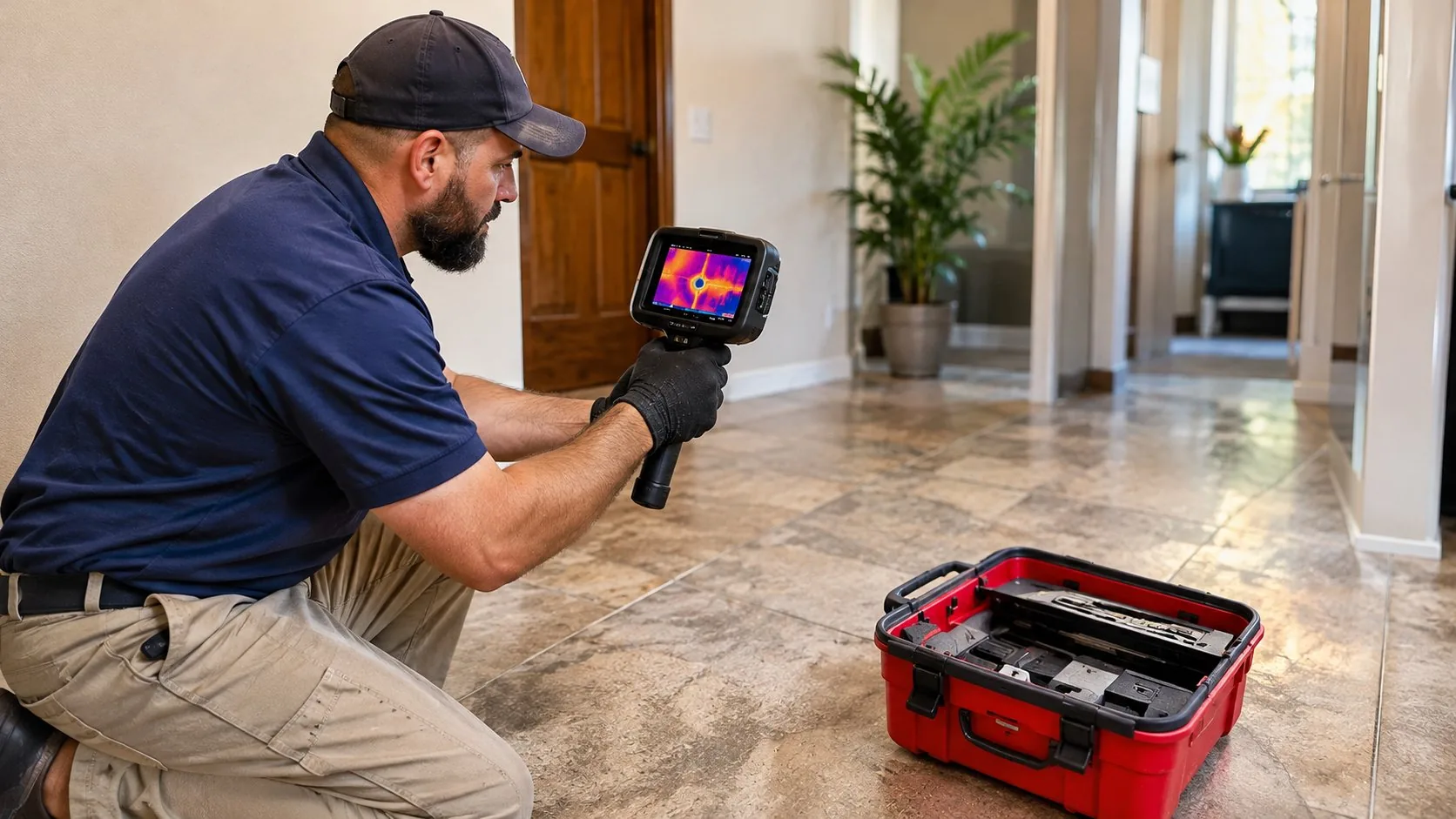
A leak on either side of the meter is on your property. If the test shows a leak and you cannot find a dripping fixture, a hidden line under the slab is a strong suspect. The next step is slab leak detection, which finds the exact spot before anything is cut.
If you are still asking how to tell if you have a slab leak, start with the meter test, because it takes half an hour and costs nothing. Knowing how to tell if you have a slab leak early can save floors and money.
Six signs of a slab leak
| Sign | What it suggests | Other things that can cause it |
|---|---|---|
| Sound of running or hissing water with every fixture off | Pressurized water escaping from a hidden pipe | A running toilet, a faulty fill valve, an irrigation timer |
| Warm or hot spot on the floor | A leak on a hot water line under the slab | A water heater or heating duct near the spot, strong sun through a window |
| Water bill rises with no change in use | Water is being used or lost without you | Seasonal watering, a toilet leak, a billing change |
| Low pressure at every faucet | A leak upstream of the fixtures | A failing pressure regulator, a partly closed main valve |
| Damp floor, musty smell, swelling baseboards | Moisture rising from under or inside the slab | A roof, window or drain leak, high humidity |
| New floor or wall cracks, or a heater that never stops | Soil movement from escaping water, or constant hot-water demand | Normal settling, a failing heater element |
No single sign proves a slab leak. The more signs that line up, and the more your meter test agrees, the more likely it is.
What to do if the test says you have a leak
- Shut the main valve at the house and leave it off if the leak is active.
- Move rugs and furniture off wet floor, and photograph the damage, the meter and your bill.
- Do not break the slab yourself. Without a locator you will probably cut in the wrong place.
- Call a plumber who finds the leak first and gives you the price in writing before cutting.
- If you may file an insurance claim, read what homeowners insurance usually covers before you start repairs.
How serious is a slab leak if you wait?
Escaping water can wash away the soil under the slab, soak flooring and drywall, and feed mold. It also keeps running up your bill. Slab leaks do not repair themselves, so it is worth testing early. If you want a sense of the budget, see what slab leak repair costs.
Questions about finding a slab leak
Can a slab leak fix itself?
No. Pipes that have started to leak keep leaking, and a small pinhole usually gets larger over time.
Does a slab leak always make the floor warm?
No. A warm spot appears mainly with leaks on a hot water line. A leak on a cold line may show up as dampness, a sound or a higher bill instead.
Is a high water bill always a slab leak?
No. Irrigation, a running toilet and seasonal use are more common causes. A meter test separates a real leak from a change in use.
Can I smell a slab leak?
Sometimes. A musty or damp smell near the floor can mean moisture is building up, but a smell alone does not confirm a leak.
How long should I watch the meter?
At least 30 minutes with no water use. A longer wait, such as an hour or two, can reveal slower leaks.
Who do I call if the meter test shows a leak?
Call a plumber who does leak detection and slab repair. A general handyman usually does not have the equipment to locate a leak under concrete.
Meter still moving? Do not wait on it.
Shut the main valve and call. A Pomona plumber will tell you what to do next.
Call (909) 415-2610More on slab leaks
- How to Prevent Slab Leaks: What Homeowners Can Do
- Slab Leak Signs by Floor Type: Tile, Wood, Carpet and Vinyl
- Slab Leak Found in a Home Inspection? A Buyer’s Next Steps
- Slab Leak in a Rental: What Renters Should Do
- Slab Leak Spot Repair: How It Works and When It Fits
- Browse the full slab leak guide
About · Contact · Privacy policy · Disclaimer