
Slab Leak Detection in Pomona, CA
We find the exact spot a pipe is leaking under your floor before anything is cut, and we show you the readings that prove it.
Further reading: EPA WaterSense: how household leaks waste water.
What slab leak detection is
A slab leak is a break in a water line that runs under or inside a concrete foundation. Detection is the step that comes before repair: it answers which pipe is leaking and exactly where. Without it, a repair means opening a large area of floor and hoping.
A warm spot on the floor is only a rough clue. Hot water travels along the pipe and warms the concrete away from the actual break, so the warm patch and the leak are often not in the same place. That is why detection uses several methods instead of one.
Detection finds and documents the leak. It does not fix it. If you already know you need a repair, see our slab leak repair options for Pomona homes.
Slab leak detection is the fastest way to turn a guess into a plan, because it shows where the pipe is leaking before any floor is cut. Good slab leak detection also gives you readings you can hand to an insurer or a landlord.
The four stages of slab leak detection
1. Pressure isolation test
We test the hot line, the cold line and the supply line separately by pressure. A line that will not hold pressure is the one that is leaking. This tells us which pipe to chase before we listen or scan, and it separates a leak under the slab from a dripping fixture or a toilet.
2. Acoustic listening
Electronic listening equipment picks up the sound of water escaping from a pressurized pipe through the floor. The sound is loudest closest to the break, so moving the sensor across the floor narrows the search to a small area.
3. Thermal imaging
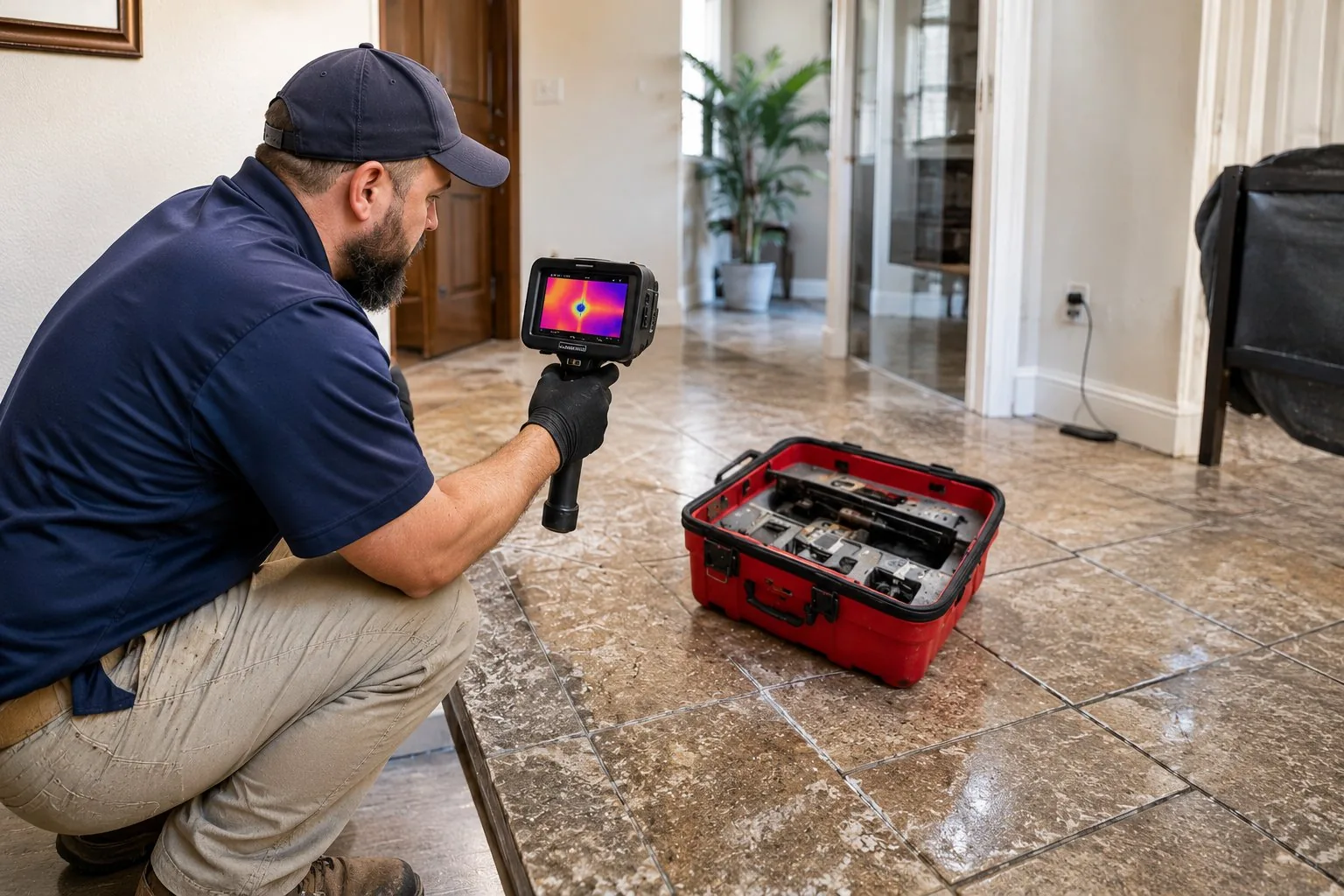
A thermal camera shows temperature differences on the floor. It works best on hot water lines, where a leak warms the surface, and it can also show wet areas that read cooler than dry concrete.
4. Line tracing
We map the route of the pipe so the mark we make is on the pipe, not beside it. Pipe paths under old slabs rarely match the drawings, and many Pomona homes have been repiped or added onto since they were built.
Confirmation before cutting
We mark the floor only when at least two methods point to the same spot. If the readings disagree, we say so and re-test instead of cutting.
What each method finds, and where it struggles
| Method | What it tells us | Works best on | Limits |
|---|---|---|---|
| Pressure isolation test | Which line is leaking | Any pressurized supply line | Does not give a location |
| Acoustic listening | Where escaping water is loudest | Active leaks on metal pipe | Plastic pipe, deep leaks and background noise weaken the signal |
| Thermal imaging | Heat and moisture patterns on the floor | Hot water line leaks | Thick floor coverings and cold lines show less |
| Line tracing | The route of the pipe | Locating the pipe before marking | Needs a clear signal on the pipe |
What you get after detection
- The readings from each method, explained in plain language.
- A marked location on the floor, with photos.
- Written repair options with a price for each, before any cutting begins.
- Documentation you can give your insurer. See whether homeowners insurance covers a slab leak.
When detection is harder
No method is perfect. Deep leaks, plastic pipe and several small leaks in the same area can blur the signal. When that happens we re-test with a different method, narrow the area, and tell you how confident we are before recommending any opening in the slab.
When to book a detection visit
Book one if you see two or more warning signs, or if your water meter keeps moving with every fixture off. Not sure? Our guide on how to tell if you have a slab leak covers the signs and a meter test you can do yourself in about half an hour.
For what a repair may cost once the leak is found, see slab leak repair cost in Pomona.
Detection cost
National reference data puts leak detection at roughly $150 to $600. Southern California labor costs can push it higher, and this is not a quote. A larger home, several suspect lines or a hard-to-reach floor adds time. Ask any plumber whether the detection fee is applied toward the repair if you go ahead. Source: HomeAdvisor via Angi, April 2024.
Slab leak detection questions
How accurate is slab leak detection?
No method is perfect. Confidence comes from agreement: when pressure testing, listening and thermal imaging all point to the same spot, cutting there is a sound decision. When they disagree, we re-test before opening the floor.
Do you have to break the concrete to find a slab leak?
No. Every stage of detection works from the surface. Concrete is opened only after the leak is located, and then only at one access point where the repair requires it.
How long does slab leak detection take?
Many visits take a few hours. A large home, several suspect lines or an unclear signal can take longer.
Can I find a slab leak with just my water meter?
The meter tells you whether water is escaping, not where. It is a good first test, and we cover the steps in our guide on how to tell if you have a slab leak.
Does detection work on plastic pipe?
It is harder. Plastic carries sound less clearly than copper, so we lean more on pressure testing and thermal imaging and tell you when a result is less certain.
Will my insurance pay for leak detection?
Some policies cover the cost of locating a leak, and others do not. Read your policy or ask your agent before you file, and keep the written detection report.
Want the leak found before anything is cut?
Call and a Pomona plumber will tell you what to do first and set up a detection visit.
Call (909) 415-2610More on slab leaks
- Slab Leak in a Condo or HOA Home: Who Is Responsible?
- Slab Leak Myths: 8 Things Homeowners Get Wrong
- Slab Leak Reroute: Replacing the Line Without Cutting the Slab
- Warm Spot on Your Floor? Slab Leak or Something Else
- Can a Slab Leak Fix Itself?
- Browse the full slab leak guide
About · Contact · Privacy policy · Disclaimer